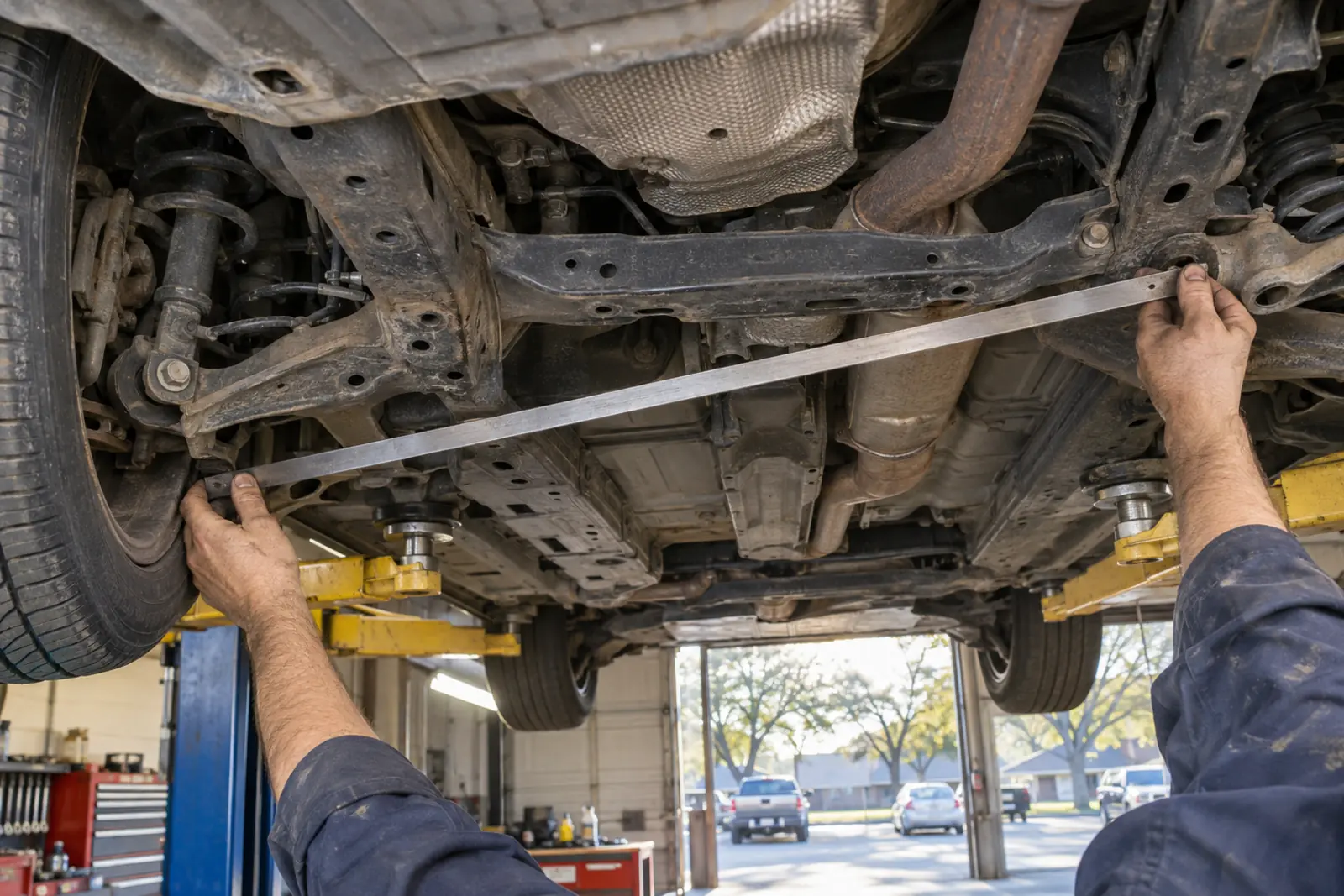
After a collision - or when evaluating a used car - one question matters more than almost any other: is there frame damage? The answer shapes every decision that follows. It affects whether a vehicle is safe to drive, how an insurance claim gets handled, what a repair will actually cost, and what the vehicle is worth once it leaves the shop. Yet most drivers have no clear picture of what frame damage actually means on a modern vehicle, what signs to look for before getting to a shop, or how a professional structural inspection works.
This guide walks through all of it in plain language. It covers the visual checks any driver can perform without tools, what a qualified body shop does during a structural inspection, how to interpret the written report, and what options exist once findings are confirmed. Where the information is specific to Texas law or the Hurst area, that is noted clearly.
What Frame Damage Actually Means on Modern Vehicles
The word "frame" comes from an older era of automotive construction. Full-size trucks, body-on-frame SUVs like the Ford F-Series, and commercial vehicles are built on a separate steel ladder frame that runs the length of the vehicle, with the body bolted on top. When people say one of these vehicles has frame damage, they mean the ladder frame itself is bent, cracked, or twisted.
Most modern passenger cars, compact SUVs, and crossovers are built differently. They use a unibody design, in which the body panels, floor, pillars, and structural members are all integrated into a single stamped-steel assembly. There is no separate frame underneath. When a collision technician or insurer says a unibody vehicle has frame damage, they almost always mean structural damage to the unibody itself. The two terms are used interchangeably in the industry, and understanding that distinction prevents a lot of confusion when reading estimates and inspection reports.
Understanding the functional zones of a unibody makes damage severity much easier to interpret:
- Crumple zones - The front and rear sections of a unibody are engineered to fold and absorb crash energy in a controlled way. A moderate front or rear collision that bends the front rails or rear rails is doing exactly what those zones were designed to do. This type of damage is repairable in most cases when properly addressed.
- The passenger safety cage - The area surrounding the occupants - including the A-pillars (the vertical supports on each side of the windshield), B-pillars (the supports between the front and rear doors), C-pillars, rocker panels, floor pan, and firewall - is designed to remain rigid and protect occupants in a crash. Deformation here is far more serious than crumple zone damage.
- Strut towers and suspension pickup points - These are where the suspension attaches to the body structure. Damage here disrupts handling geometry, affects tire wear, and can make a vehicle unsafe to drive before any visible symptoms become obvious.
- The firewall - The steel partition between the engine bay and the passenger compartment. Any intrusion of the firewall toward the cabin is a significant structural and safety concern.
The practical distinction between crumple zone damage and safety cage damage drives the difference between a repair that restores a vehicle to safe factory condition and one that cannot. A body shop that performs a thorough structural inspection should be able to tell you clearly which category the damage falls into - and should be willing to explain it in plain terms.
Visual Signs Any Driver Can Spot Without Tools
You do not need a measuring system or a lift to notice the most common indicators of structural damage. The following checks are worth performing before taking any vehicle to a shop - whether it is your own car after a collision or a used vehicle you are considering buying in the DFW area.
Panel Gaps and Body Alignment
Open and close every door, the hood, and the trunk or liftgate. Watch the gap between each panel and its surrounding body. Factory gaps are consistent - typically a few millimeters wide and even along their entire length. Gaps that are wider on one side than the other, that taper to nearly nothing at one end, or that change as a door swings open are a sign that the surrounding structure has shifted from its factory position.
Pay particular attention to the gap between the top of a door and the roofline, and between the door edge and the B-pillar. These are sensitive indicators of rocker panel and pillar damage, two areas that are part of the passenger safety cage.
How Doors and Windows Operate
A door that requires extra effort to close, that does not latch cleanly on the first try, or that makes grinding contact with the door sill is telling you something about the structure around it. Structural movement shifts the door opening out of square. The same applies to windows that no longer track smoothly in their channels or that sit unevenly in the frame when fully closed. These are not just wear issues - on a vehicle with recent collision history, they are structural flags.
Visible Creasing and Buckling
Get down low and look along the lower rocker panels - the sill section between the front and rear wheels on each side. Any rippling, wrinkling, or buckling in the sheet metal there is a significant red flag. Rocker panels are part of the safety cage and are not designed to fold. Even minor crinkling along the rocker indicates a force was transmitted through that structural member.
Open the hood and look at the inner fender structure on each side. The strut towers - the raised domed structures where the front suspension attaches - should be smooth and symmetrical. Creases, cracks in the paint running from a stress point, or any asymmetry between left and right suggest impact damage that has reached the front structural section beyond the designed crumple zone.
Uneven Tire Wear
Structural damage almost always throws alignment out of specification, because the geometry that alignment is adjusted against - the positions of the suspension pickup points relative to the vehicle centerline - has changed. If a vehicle pulls consistently to one side while driving straight, or if tire wear is significantly heavier on one side or on the inner or outer edge of the tread, structural distortion is one possible cause. Worn suspension components and simple misalignment are also common culprits, but on a vehicle with collision history, tire wear asymmetry is a prompt to investigate further.
Underbody Inspection
If you have access to a lift or can safely get a vehicle on ramps, the underbody can tell you a great deal that the exterior hides. Look for:
- Kinked or bent frame rails running front to back along the lower structure
- Fresh undercoating or paint applied over a large area that does not match the age or appearance of the rest of the underbody - a common way to conceal prior repair work
- Welds that look different from the uniform spot welds visible on the rest of the unibody - non-factory welding indicates past structural repair
- Broken or missing structural seam sealer, which often cracks and separates when the surrounding structure has been deformed and re-worked
- Asymmetry between the left and right frame rails - measuring roughly from the same point on each side, they should be mirror images of each other
Indicators in the Engine Bay
Look at the radiator support - the crossmember at the very front of the engine bay. It should sit square and undamaged. Check whether the front clip and hood appear to sit level and symmetrically from side to side. Fresh paint overspray in areas that would not normally be painted during a standard refinish - inside bolt holes, behind hood hinges, on the back face of the radiator support - can indicate that prior repair work was performed in this area.
What a Shop Looks for During a Structural Inspection
When a qualified body shop performs a structural inspection, the visual checks above are just the starting point. A professional inspection goes significantly further and relies on equipment that no walkaround can replicate.
Computerized Measuring Systems
The most reliable tool in structural inspection is a computerized measuring system. Vehicle manufacturers publish precise three-dimensional measurements for every structural reference point on every model - the exact X, Y, and Z coordinates where suspension components attach, where pillars meet the floor pan, where the firewall meets the floor, and dozens of other critical locations.
A shop using systems such as Car-O-Liner, Celette, or Chief Automotive's electronic measuring equipment places sensors at multiple points on the vehicle and compares actual measurements to factory specifications. Any deviation beyond tolerance is flagged. Tolerances are measured in millimeters - modern vehicles and their safety systems are designed and manufactured to that level of precision.
This precision matters well beyond aesthetics. Advanced Driver Assistance Systems (ADAS) - including automatic emergency braking, lane keep assist, and blind spot monitoring - rely on sensors mounted in precise positions relative to the vehicle structure. If the structure is out of specification, those sensors cannot be calibrated accurately after repair. The same applies to airbag deployment angles, which are engineered around the assumption that the structure is intact and within factory tolerances.
Inspection of Welds and Repair History
Factory welds have a distinctive appearance - uniform spot welds spaced at consistent intervals, applied by automated equipment to precise specifications. When a shop repairs a structural section, the replacement welds look different from factory work. A trained structural technician can identify non-factory welds and determine whether prior repair work was performed and to what standard.
This is particularly important when evaluating a used vehicle. A prior structural repair performed correctly, using factory procedures, certified welding techniques, and OEM specifications, is very different from hasty or non-standard repair work. The presence of prior repair is not automatically disqualifying - but the quality of that repair matters enormously.
Paint Thickness Measurement
Ultrasonic paint thickness gauges detect whether panels have been repainted. Factory paint is applied to a consistent, predictable thickness. A repainted panel reads differently. A shop using this tool on a used vehicle can quickly map which panels have been refinished, pointing to prior damage and repair work even if no accident history appears on a vehicle history report. In Texas, where private vehicle sales do not require the same disclosures as dealer sales, this tool is particularly useful for used car buyers.
Hidden Area Inspection
Many structural members are hidden by trim, carpeting, or plastic panels. A thorough inspection includes pulling back trunk liners, lifting floor mats, and removing kick panels to examine the actual structural steel underneath. Some of the most significant damage hides under interior trim - a buckled floor pan or a cracked inner rocker panel will not show on a surface-level walkaround, and yet both are part of the passenger safety cage.
How to Read a Structural Inspection Report
If a shop performs a computerized structural inspection, ask for the measurement report in writing before authorizing any repair work. Here is how to interpret what you receive:
- Measurement points - Each row in the report typically represents one structural reference point on the vehicle, identified by a code or plain description such as "front left strut tower" or "right rear rail."
- Specification value - The factory-published figure for that point, pulled from manufacturer data.
- Actual value - What the measuring system recorded on the specific vehicle being inspected.
- Deviation - The difference between actual and specification, expressed in millimeters.
- Tolerance - The acceptable range of deviation. Points outside tolerance are flagged, often highlighted in red or marked with a notation in the report.
A report showing several flagged points in the front crumple zone - with all safety cage reference points within tolerance - tells a meaningfully different story than a report with flagged B-pillar or floor pan measurements. The location of out-of-spec points matters as much as the number of them.
Ask the technician to walk through the report with you. Any qualified structural technician should be able to explain which flags represent repairable crumple zone deformation and which represent more serious safety cage concerns. If a shop cannot or will not explain a measurement report in plain language, that itself is useful information when deciding where to authorize repair work. For more detail on what happens after a structural inspection confirms damage and repair is recommended, the guide on frame and structural damage repair covers the repair process step by step.
Frame Damage Versus Cosmetic Damage: Key Differences
Not every dent, crease, or scrape is a structural concern. The practical distinction between structural and cosmetic damage determines your repair options, insurance treatment, resale value impact, and long-term safety.
Cosmetic damage affects the vehicle's appearance but does not compromise the structural members that protect occupants or maintain the vehicle's handling geometry. Examples include:
- A dent in a door skin that did not intrude into the door beam or the adjacent B-pillar
- Scratches or paint damage on any outer body panel
- A damaged bumper cover where the underlying bumper beam and the structural rails behind it are undamaged
- Hail damage to hood, roof, or deck lid panels without underlying structural deformation
- A broken headlight or taillight assembly and the surrounding trim
Structural damage means deformation of a load-bearing member - the components the vehicle's occupant protection depends on. Examples include:
- Bent or kinked front or rear frame rails
- Deformed strut towers that have shifted the suspension attachment point
- Bent, cracked, or compressed A-pillars, B-pillars, or C-pillars
- Buckled or kinked rocker panels
- Deformed or buckled floor pan
- Any firewall intrusion toward the passenger compartment
- Severe radiator support deformation that has pulled the front clip out of alignment with the structural rails
One common source of confusion: a vehicle can have significant cosmetic damage - torn bumper covers, smashed fenders, broken lights, missing trim - without any structural damage underneath. And a vehicle can have structural damage with relatively minor visible cosmetic damage, particularly in lower-speed side impacts that load the rocker panels or B-pillars directly. The appearance of a vehicle after a collision is not a reliable guide to its structural condition. That is exactly why inspection matters.
This distinction carries real financial weight. Structural damage is disclosed on a vehicle's history when reported through insurance, and it affects resale value and financing eligibility in ways that cosmetic damage typically does not. Texas used-car dealers are required to disclose known structural damage under the Texas Deceptive Trade Practices Act. Private sellers operate under different obligations, which is one reason a professional inspection before purchasing a used vehicle in Texas is worth the cost.
When Structural Damage Crosses Into Total-Loss Territory
Texas law governs when an insurer can declare a vehicle a total loss. The core rule is cost-based: if the estimated repair cost meets or exceeds the vehicle's actual cash value (ACV) before the loss, the insurer may declare a total loss. The Texas Department of Insurance publishes guidance on the current threshold - check tdi.texas.gov for the most current rule, as it can be revised. As of recent years, Texas has generally applied a threshold in the range of 100 percent of ACV.
Structural severity creates a parallel consideration that can push a vehicle toward total loss even when the cost calculation alone might not:
- Some structural damage patterns make it technically impossible to restore a vehicle to factory safety specifications, regardless of how much money is spent. Crushed B-pillars, severe firewall intrusion into the passenger compartment, or multiple simultaneous failures in the safety cage may fall into this category.
- OEM certification programs and manufacturer repair procedures sometimes prohibit repair of certain structural members and require section replacement instead - which can push repair costs significantly higher than a surface estimate suggests, potentially crossing the total-loss threshold on a vehicle that initially appeared repairable.
- A vehicle that has been structurally repaired and correctly restored to factory specification is fundamentally different from one that cannot be fully restored. The former may be a sound and safe repair. The latter is effectively a total loss regardless of what the dollar calculation shows.
If a structural inspection produces findings suggesting the damage may push the vehicle toward total loss territory, the guide on total loss rules in Texas explains how the ACV determination works, what your rights are if you disagree with the insurer's valuation, and how to protect your position through the process.
One point worth knowing about Texas specifically: if an insurer declares a total loss but the owner wants to keep the vehicle, Texas law allows it. The insurer pays the ACV minus the salvage value, and the vehicle receives a salvage title. A vehicle on a salvage title cannot be licensed for road use until it passes a rebuilt vehicle inspection through the Texas Department of Motor Vehicles, and it carries a rebuilt or salvage notation on its title permanently - which affects insurance availability and resale value going forward.
What to Do If Inspection Confirms Frame Damage
If a professional structural inspection confirms significant structural damage, the right next steps depend on context - whether this is your vehicle after a collision, a vehicle you are evaluating for purchase, or a vehicle already in the middle of an insurance claim.
After Your Own Collision in Hurst or the Mid-Cities Area
Get the inspection report in writing from the shop that performed it. This document is evidence. Texas is an at-fault state: if another driver caused the collision, their liability coverage is responsible for restoring your vehicle to its pre-loss condition, including any necessary structural repairs. If you are using your own collision coverage, your carrier pays and then subrogates against the at-fault party.
Under Texas law, you have the right to choose your own repair facility. An insurer can recommend shops from its network, but it cannot legally require you to use one of them. If you want repairs performed by a shop that holds specific OEM structural certifications or I-CAR Gold Class status - both meaningful indicators of training and equipment investment - you can direct your vehicle there. The article on choosing a collision repair shop and your rights in Texas covers how to evaluate a shop's qualifications and how to handle insurer pressure to use a specific provider.
If You Are Buying a Used Car
Confirmed structural damage on a vehicle you have not yet purchased gives you clear negotiating leverage - or grounds to walk away entirely. The key questions to ask and verify are: Was prior structural repair performed? If so, to what standard, and can it be verified with a measurement report showing current factory-spec compliance? What does the vehicle measure today, regardless of its history?
A vehicle with a structural repair history is not automatically one to avoid. But it demands verification. A shop with computerized measuring equipment can tell you whether a repaired vehicle currently sits within factory specification. That is the question that matters for safety and ongoing value - not simply whether repair was done, but whether the result meets the standard it needs to meet.
When the Damage Is Severe
If structural findings are serious - bent pillars, floor pan intrusion, firewall damage, multiple out-of-spec safety cage points - consider getting a second opinion before committing to a repair path. Not every shop has the equipment, certified training, and OEM authorizations to handle complex structural repairs to the highest standard.
I-CAR Gold Class certification and OEM certification programs from manufacturers including GM, Ford, Stellantis, Honda, Toyota, and others identify shops that have invested in the specific training and equipment required for structural work. The Hurst area, as part of the mid-cities corridor between Dallas and Fort Worth, has access to shops holding these credentials. Verifying certification status before authorizing significant structural repair is a straightforward step that protects both the quality of the work and your ability to pursue warranty claims if the repair is later found deficient.
Whatever the findings, a written structural inspection report - not a verbal summary, not a rough estimate - is the document that drives every decision that follows. Ask for it, read it carefully, and do not authorize major structural repair work without understanding what it says.
Frequently Asked Questions
Can a car with frame damage be driven safely?
It depends on the location and severity of the damage. Minor crumple zone damage to front or rear rails may leave a vehicle driveable in the short term, but any deformation of the passenger safety cage, steering components, or suspension pickup points creates real safety concerns. If a professional structural inspection finds significant structural damage, the vehicle should not be driven regularly until a qualified technician has assessed whether it is roadworthy. ADAS sensors may also be compromised in ways that are not immediately obvious from driver behavior.
Does frame damage automatically total a car in Texas?
No. Texas uses a cost-based rule: if repair cost meets or exceeds the vehicle's actual cash value, the insurer may declare a total loss. Many structural repairs fall well within that threshold, particularly on newer or higher-value vehicles. However, some damage patterns - crushed B-pillars, severe firewall intrusion, or multiple simultaneous safety cage failures - may make a vehicle unrepairable to factory safety specification regardless of cost, effectively making it a total loss on technical grounds even before the dollar calculation is applied.
How much does a structural inspection cost?
Many collision repair shops include a structural assessment as part of a standard damage estimate at no charge. A standalone pre-purchase structural inspection at a qualified shop typically ranges from about $100 to $200, though prices vary by shop and market. Confirm in advance what the inspection includes - a computerized measuring inspection using manufacturer reference data is the only method that reliably confirms whether key structural points are within factory tolerance, and it is meaningfully different from a visual walkaround.
How do I check for frame damage on a used car I'm buying?
Start with a vehicle history report such as CARFAX or AutoCheck to surface any reported accidents, then look for uneven panel gaps, doors that do not close cleanly, mismatched paint, and fresh undercoating in areas that would not normally have it. These are surface indicators only - the definitive check is a professional inspection using computerized measuring equipment, which is the only way to confirm whether structural reference points fall within factory specification. No visual inspection, however thorough, substitutes for actual measurement.
What is the difference between frame damage and structural damage?
In practice the terms are interchangeable in the collision repair industry and among insurers. Technically, frame damage refers to the separate steel ladder frame found on body-on-frame trucks and older SUVs, while structural damage refers to deformation of the integrated unibody found on most modern passenger cars and crossovers. Because the majority of vehicles on the road today use unibody construction, structural damage is the more precise term - but both expressions are used to describe the same general category of damage in everyday usage.
Can frame damage be fully repaired?
Crumple zone damage - bent front or rear rails designed to absorb crash energy in a collision - can often be straightened to factory tolerance using a frame straightening machine, then verified with computerized measuring before the vehicle leaves the shop. Damage to the passenger safety cage is a different matter: some repairs are possible with certified section replacement and factory-specification welding procedures, but severe intrusion, crushed pillars, or multiple simultaneous structural failures may make it impossible to restore the vehicle to safe factory specification. A qualified structural technician with proper measuring equipment is needed to make that determination - it cannot be reliably assessed from photographs or a visual estimate.