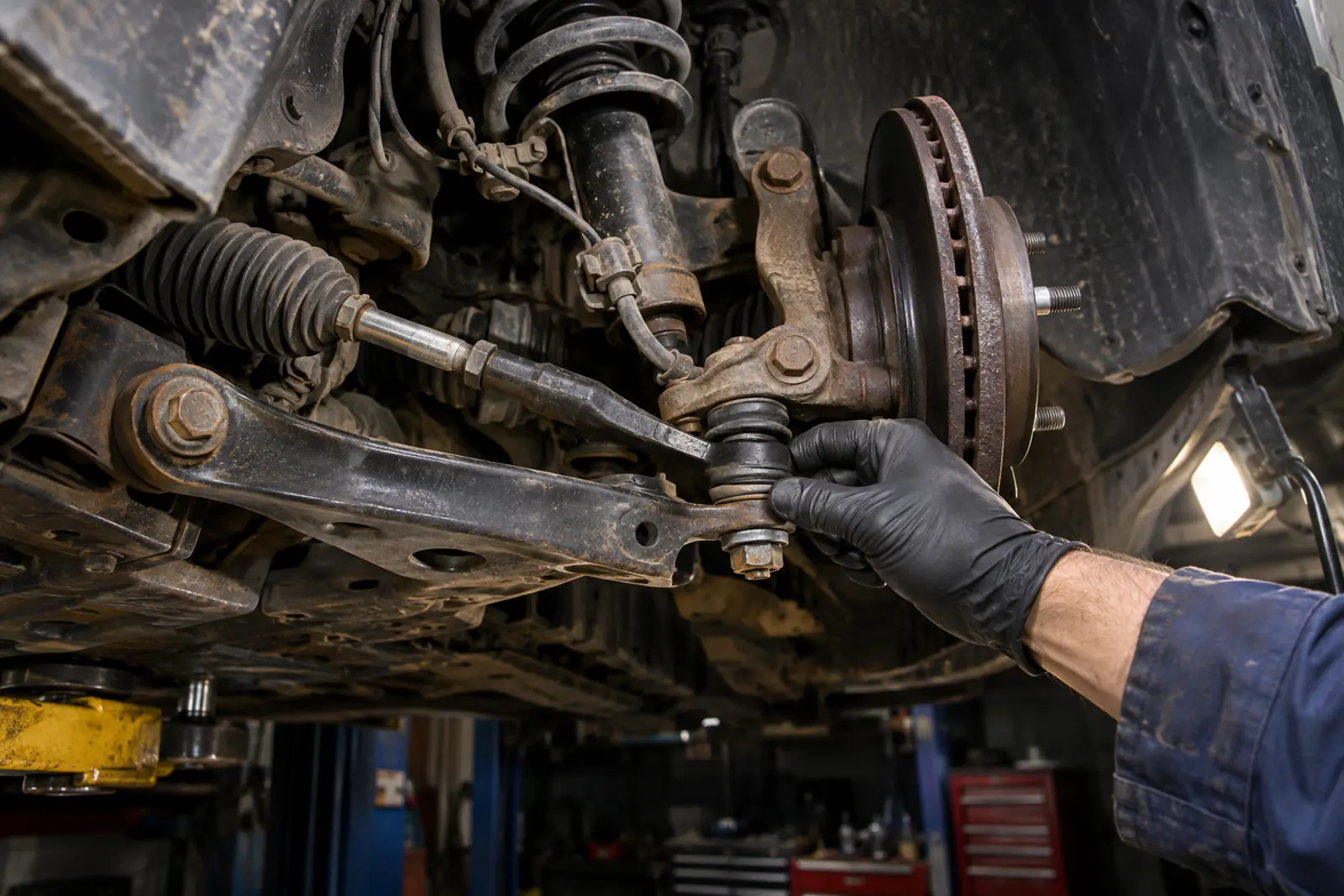
Your front bumper is crushed, the hood is buckled, and the airbags may or may not have fired. After a collision anywhere in Hurst, TX, the visible damage is obvious enough to photograph and argue over with an adjuster. What is far harder to see - and far easier to miss entirely - is what happened underneath the car. The suspension and steering systems that keep your wheels pointing the right direction and absorb every jolt on Airport Freeway are made of dozens of steel and aluminum components, any one of which can bend, crack, or shift out of position in a collision that looks almost minor from the outside. This guide explains which parts are most at risk, how to recognize the symptoms, how a qualified body shop in Hurst diagnoses the damage, and how to make sure your insurance claim covers every component that needs to be repaired.
Why Suspension Damage After a Collision Is So Easy to Overlook
When you walk around your car after an accident, you can photograph the crumpled sheetmetal, the broken taillight, and the paint transfer from the other vehicle. What you cannot see from the parking lot is a bent control arm, a cracked steering knuckle, or a tie rod that is now slightly out of position. These components live behind plastic shields, inside wheel wells, or underneath the vehicle entirely. The damage does not announce itself with a warning light or a visible gap in the metal. In many cases the car still drives, still steers, and still feels almost normal - at first.
That phrase "at first" is the problem. Suspension components that are bent or shifted out of position put abnormal stress on tires, wheel bearings, and adjacent parts. A tie rod that is bent two degrees will wear out your front tires in a few thousand miles and make the car handle unpredictably at highway speed. A strut mount that cracked in the impact may feel fine in a parking lot but transmit hard vibration through the steering wheel at 65 mph on the airport freeway. Insurance adjusters working from photographs or a quick visual walkthrough can miss these issues entirely - and so can drivers who assume that because the car seems to drive, it was not seriously damaged.
Hurst sits at the junction of several busy corridors - Airport Freeway (183), Precinct Line Road, Harwood Road, and Pipeline Road - with heavy traffic, frequent large trucks, and pavement that is not always gentle on vehicles. A suspension that has been compromised by a collision will degrade noticeably faster on these roads. Getting the damage properly diagnosed is not bureaucratic box-checking. It is a safety matter.
Suspension and Steering Components Most Commonly Damaged in a Collision
The suspension and steering systems work together to keep the tires in contact with the road and translate your steering inputs into actual wheel movement. A collision can damage any of the following interconnected parts:
- Tie rods (inner and outer): Tie rods link the steering rack to the steering knuckle on each front wheel. Even a low-speed frontal impact can bend an outer tie rod, causing the wheel to point inward or outward - a condition called toe error. This is one of the most commonly damaged suspension components after a front-end collision and among the least expensive to fix, but only if it is diagnosed and replaced.
- Control arms and bushings: Upper and lower control arms position the wheel relative to the vehicle's body. A direct impact or even a hard side-loading force can bend a control arm or crack its rubber bushings. Bent control arms often show up only as an out-of-range alignment reading until the vehicle is put on a lift for a thorough visual inspection.
- Ball joints: Ball joints connect the control arm to the steering knuckle and allow the wheel to pivot during steering and suspension travel. A collision can crack or loosen a ball joint. A failing ball joint is not merely an alignment nuisance - it is a structural failure in progress, since a separated ball joint can cause sudden, complete loss of steering control at speed.
- Struts and shock absorbers: Struts are structural members as well as dampers. A front-end collision or hard corner impact can bend a strut tube, crack the strut mount, or damage the upper strut bearing. A bent strut cannot be realigned - it must be replaced. Bent struts often cause a characteristic pull to one side that no amount of alignment adjustment will correct.
- Wheel bearings and hub assemblies: A side impact or hard curb strike that accompanies a collision can damage the wheel bearing, which is pressed into the steering knuckle and supports the wheel hub. A damaged wheel bearing makes a grinding or humming noise that grows louder with speed, and in severe cases can allow the wheel to wobble under load.
- Steering rack and pinion: The steering rack translates your steering wheel inputs into side-to-side movement of the tie rods. A serious front-end collision can crack the rack housing, strip internal gear teeth, or displace the rack from its mounts. Rack damage typically produces a loose or imprecise steering feel and sometimes a knocking sensation when turning.
- Sway bars and end links: Sway bars (also called stabilizer bars) resist body lean during cornering. Their end links are relatively slender rods that can snap in a side impact or even during the violent secondary movements that follow a collision. Broken sway bar end links cause a knocking noise over bumps and noticeably increased body roll through corners.
- Subframe and cradle: The subframe is the steel structure to which the engine, transmission, and front suspension attach. In a moderate to severe front-end collision, the subframe can crack, bend, or be pushed backward relative to the unibody. Subframe damage is expensive to repair and must be identified using a computerized frame measuring system, not just a visual inspection from underneath.
- Steering knuckle and spindle: The steering knuckle holds the wheel bearing and hub assembly and connects to both the control arm and the tie rod. A direct wheel impact - like striking a curb during a collision - can crack or bend the knuckle. A cracked knuckle is a critical safety component that must be replaced, not welded or straightened.
Warning Signs That Your Suspension or Steering Was Damaged
Some of these symptoms appear immediately after the collision. Others develop over days or weeks as a damaged component is subjected to normal driving stress. Take any of them seriously regardless of when they appear:
- Vehicle pulls to one side without any steering input, particularly at highway speed.
- Steering feels loose, vague, or requires constant small corrections to maintain a straight line.
- Steering wheel is off-center when driving straight on level pavement.
- Vibration through the steering wheel at certain speeds or during braking.
- Clunking, knocking, or popping sounds over bumps, railroad crossings, or during low-speed turns.
- Grinding or humming noise that changes in pitch with vehicle speed (a classic wheel bearing symptom).
- Uneven or accelerated tire wear - this develops over weeks rather than immediately but is a reliable indicator of alignment or geometry problems.
- Vehicle sits visibly lower on one corner compared to the others.
- Increased body lean through corners compared to before the accident.
- Tires that look visibly angled inward or outward when you crouch down and look along the side of the car.
None of these symptoms are normal for a vehicle that was not in a collision. If you notice any of them after an accident in Hurst, the car needs to go onto a lift at a qualified collision or suspension shop before you put more miles on it - particularly before driving on any high-speed roads in the area.
Front-End, Rear-End, and Side-Impact Collisions: Which Components Are Most at Risk
The nature of the collision largely determines which suspension and steering components face the greatest risk.
Front-end collisions place the most stress on the front suspension and steering system. Tie rods, control arms, ball joints, the steering rack, and the front subframe are all directly in the path of impact energy. Even a collision at 15 to 20 mph - the kind that causes cosmetic damage to the bumper cover and grille - can bend a tie rod or displace the subframe enough to put the front suspension completely outside of its design geometry. Front-end collisions also stress the strut mounts and upper strut bearings, particularly when the collision happens while the steering wheel is turned, which transfers lateral force directly through the strut.
Rear-end collisions are more variable depending on the vehicle. Trucks and body-on-frame SUVs that are common throughout Tarrant County - F-150s, Silverados, Expeditions, Tundras - have rear leaf springs and solid axles that are relatively robust, though they can still bend under severe impact. Unibody sedans and crossovers have more complex rear suspension setups involving multiple control arms, trailing arms, and toe links that can be damaged in even a moderate rear impact. Rear wheel bearings are also vulnerable in a rear collision, especially if the impact includes any sideways component.
Side impacts transfer force directly into the lateral control arms and sway bar on the impacted side. A T-bone collision or a hard parking-lot sideswipe that pushes the door panel inward can easily bend the lower control arm on that corner without leaving any visible damage to the wheel or tire from outside the vehicle.
Curb strikes and secondary impacts frequently accompany collisions and are easy to overlook in an insurance estimate because they do not look like collision damage from a distance. When a vehicle is pushed sideways by another car and strikes a curb, the wheel takes a sharp lateral blow that can crack the steering knuckle, damage the wheel bearing, and bend the wheel rim all at once. These secondary impacts are often the source of suspension problems that surface weeks after the original repair was completed.
How a Qualified Collision Shop in Hurst Diagnoses Suspension Damage
A thorough suspension inspection after a collision is not a ten-minute walkthrough. It requires putting the vehicle on a lift, getting all four wheels off the ground, and working methodically through every component. Here is what that process looks like at a shop doing the job correctly:
Visual inspection on a lift: With the vehicle elevated and the wheels hanging free, a technician can inspect control arms, tie rods, ball joints, sway bar links, and the steering rack for bending, cracking, or obvious displacement. Some damage is immediately visible - a bent control arm has a discernible bow to it, and a cracked strut mount shows a gap in the metal that cannot be missed once you are looking at it directly.
Steering component play check: Each tie rod end, ball joint, and steering rack is checked for looseness by shaking the wheel while watching for movement at each joint. A ball joint with any detectable play has failed and must be replaced. This is not a subjective judgment - manufacturers publish specifications for the maximum allowable play at each joint, and a component that exceeds those specifications is out of service.
Four-wheel alignment measurement: The alignment machine does more than indicate whether an adjustment is needed. It shows what adjustments are even possible within the design of the suspension. If the front camber is severely negative on one side and no adjustment can bring it into range, that tells the technician that a strut, control arm, or other structural component is bent and must be replaced before alignment can be achieved. Alignment readings are, in this sense, a diagnostic tool - not just a finishing step.
Frame and subframe measurement: For moderate to severe collisions, a reputable collision shop uses a computerized frame measuring system to verify that the subframe, strut towers, and unibody mounting points are within manufacturer specifications. If the subframe has been displaced even a small amount, it throws every suspension geometry measurement off in ways that alignment adjustments alone cannot resolve.
Road test before and after repair: A road test on Hurst-area roads - ideally including some highway miles on Airport Freeway or Loop 820 - can reveal pulling, vibration, and noise that is not obvious in a shop setting. Many collision shops perform a documented pre-repair road test specifically to establish the symptoms for the insurance claim and to have a baseline for comparison after the repair is complete.
Alignment After Collision Repair: What "Fixed" Actually Means
This distinction causes real confusion between vehicle owners, insurance adjusters, and repair shops, and it is worth understanding clearly. Wheel alignment and suspension component repair are related but are not the same thing.
Alignment is the adjustment of angles - toe, camber, and caster - to bring the wheels back to the manufacturer's specified position. Modern alignment machines can measure and adjust these angles with considerable precision. But alignment can only work within the adjustment range that the suspension design allows. If a control arm is bent, no alignment adjustment will bring the wheel geometry back to spec. The bent component must be replaced first. Only then can alignment be performed to completion.
This is why the phrase "we'll just align it" after a frontal collision is a red flag. Alignment is the last step of a completed suspension repair, not a substitute for it. If a shop tells you that your car just needs an alignment after a collision, ask to see the alignment printout before and after the adjustment. It should show all four corners within the manufacturer's acceptable range. If any angle is at the extreme end of the adjustment range, or if only some of the readings can be brought within spec, there is likely a component that needs to be replaced.
Insurance adjusters sometimes approve a wheel alignment while declining to pay for the control arm or tie rod that actually needs replacement. In Texas, your insurance policy is required to restore your vehicle to its pre-loss condition. If proper suspension geometry cannot be achieved without replacing a component, that component is part of the collision repair and belongs in the covered estimate. Your shop can document this with an alignment printout showing out-of-range readings that cannot be corrected by any available adjustment - this is the most straightforward way to demonstrate to an insurer that a part replacement is necessary.
Your Insurance Claim and Suspension Repair
Suspension damage caused by a collision is a covered loss under virtually every collision and liability policy. The practical challenge is that it is frequently missed in the initial estimate and enters the process as a supplemental claim once the vehicle is on the lift and disassembled.
What a supplemental claim involves: When a collision shop writes the initial estimate, some damage is not visible until the bumper cover is removed, the wheels are off, and the components are inspected closely. If the original estimate approved by the insurer does not include a bent control arm that the technician finds during disassembly, the shop submits a supplemental claim for the additional work. Texas insurance regulations require insurers to handle claims promptly and in good faith, which includes responding to properly documented supplemental claims for collision-related damage.
Documenting the damage: Photographs of each damaged component before removal, alignment printouts showing out-of-spec readings, and written inspection notes from the technician are the primary documentation for a suspension damage claim. A thorough collision shop will photograph every damaged part before it is taken off the vehicle, record the alignment angles before and after repair, and provide a written explanation of why each component is being replaced rather than adjusted or reused. This documentation protects you if the insurer challenges any line item on the supplemental.
OEM versus aftermarket suspension parts: As with body panels and bumpers, insurance companies sometimes attempt to substitute aftermarket suspension parts for original equipment manufacturer (OEM) components. For safety-critical suspension parts - tie rod ends, ball joints, control arms, and steering racks - the argument for OEM parts is especially strong. OEM components are engineered to the exact geometry of the original suspension design. An aftermarket tie rod that is dimensionally close but not exactly correct can introduce caster error or toe bias that cannot be fully corrected by alignment adjustments. If your shop recommends OEM suspension parts, make sure that preference is documented in the estimate and push back if the insurer tries to substitute aftermarket equivalents on safety-critical items.
Diminished value: Severe suspension damage - particularly subframe damage or steering rack replacement - can contribute to a diminished value claim. Texas allows first-party diminished value claims in some circumstances, and the presence of significant structural or suspension repair in the vehicle history is one of the factors that affects market value. The separate guide on diminished value claims on this site covers that process in detail.
Suspension Repair Costs: What to Expect in the Hurst, TX Area
Suspension repair costs vary considerably depending on which components are damaged, whether OEM or aftermarket parts are used, and the labor rates at the specific shop. The figures below are general reference ranges intended to help you understand the scope of what may be involved. Always get a written itemized estimate from your shop and verify current pricing, since parts costs and labor rates change over time.
- Outer tie rod replacement (one side), including alignment: Roughly $150 to $400 depending on the vehicle. Inner tie rod replacement is a more involved job and typically costs more. Both sides are often replaced at the same time if one is damaged, since the components have the same age and wear history.
- Lower control arm replacement (one side), including alignment: Roughly $300 to $800. Vehicles where the ball joint is pressed into and sold as part of the control arm assembly cost more because the entire arm assembly must be replaced when the ball joint fails.
- Front strut assembly (one side): Roughly $300 to $700 per corner depending on the vehicle and whether OEM or aftermarket parts are used. Many shops recommend replacing struts in pairs to maintain even handling. Rear struts on crossovers and sedans are typically similar in price range.
- Wheel bearing and hub assembly: Roughly $200 to $600 per corner depending on whether the bearing can be pressed out of the existing knuckle or whether the entire hub and knuckle assembly must be replaced due to cracking.
- Steering rack and pinion replacement: Roughly $800 to $2,000 or more for parts and labor depending on the vehicle. Rack replacement is a significant job on most modern vehicles and always requires a full alignment afterward.
- Subframe repair or replacement: This is the most significant category. A cracked or severely bent subframe may require cutting, welding, and reshaping on a frame bench, or complete replacement of the subframe assembly. Costs can range from roughly $1,500 to $5,000 or more depending on the vehicle and the extent of the deformation.
- Four-wheel alignment: Roughly $80 to $150 as a standalone service. After collision-related suspension repair, alignment is part of the repair process and should be included in the total estimate - not added as a separate line item after the fact.
These figures are illustrative only. The only reliable number for your specific vehicle and damage is a written estimate from your shop based on a physical inspection with the car on a lift.
Frequently Asked Questions
Can I keep driving after a collision if the car still seems to steer okay?
Use caution. Suspension and steering damage is not always obvious from behind the wheel. A tie rod near failure, a ball joint with play in it, or a bent strut can feel almost normal at parking-lot speeds but become dangerous at highway speed or during emergency maneuvers. If you have been in a collision anywhere in Hurst, limit your driving until the suspension has been inspected on a lift - especially before getting on Airport Freeway, Loop 820, or any other high-speed road in the area.
Will my insurance cover suspension damage from a collision?
Yes, if the suspension damage is a direct result of the collision it is a covered loss under your collision coverage, or under the at-fault driver's liability coverage if they are responsible. The practical challenge is documentation - damage to internal components often is not fully visible until the car is on a lift, so it frequently arrives as a supplemental claim after the initial estimate is approved. A reputable shop will document every finding with photos and an alignment printout to support that supplemental claim.
How do I know whether the shop actually fixed the suspension or just ran an alignment?
Ask for the before-and-after alignment printout. The printout shows all four wheel angles alongside the manufacturer's acceptable range. If bent components were replaced and the alignment was performed correctly, every reading should fall within spec - not at the extreme edge of the adjustment range. If the shop cannot or will not provide that printout, treat it as a red flag worth investigating before you accept delivery of the vehicle.
Can a bent subframe be repaired, or does it always need to be replaced?
Minor subframe distortion can sometimes be corrected on a frame bench, but severe bends or cracks typically require replacement of the subframe assembly. The correct decision depends on deformation measurements from a computerized frame measuring system, not a visual walkthrough. A shop with proper measuring equipment can show you exactly how far out of specification the subframe is and whether repair or replacement is the appropriate approach for your specific vehicle.
What is the difference between a vehicle pulling to one side and a simple alignment problem?
Pulling can be caused by an out-of-spec alignment, but it can also be caused by a bent or damaged suspension component. If a shop performs an alignment and the car still pulls, or if certain angles could not be brought within the acceptable range, that is a strong indicator that an underlying component needs to be replaced before alignment can have any effect. Persistent pulling after a correct alignment should trigger a more thorough inspection of the control arms and strut on the side the car pulls toward.
Does suspension damage affect my vehicle's resale value?
Properly repaired suspension damage - meaning damaged components replaced with correct parts and accurate alignment performed afterward - should restore the vehicle to pre-loss handling and safety characteristics. However, significant collision repair including suspension work shows up on the vehicle history report, which can reduce resale value. If the damage was substantial, you may have grounds for a diminished value claim in Texas; the separate guide on this site covers that process in detail.
If your vehicle was recently in a collision anywhere in the Hurst area and you have questions about what damage may need to be repaired or how to document it for your insurance claim, use the contact page to get started. A thorough inspection on a lift is the only way to know for certain what a collision actually did to your suspension.